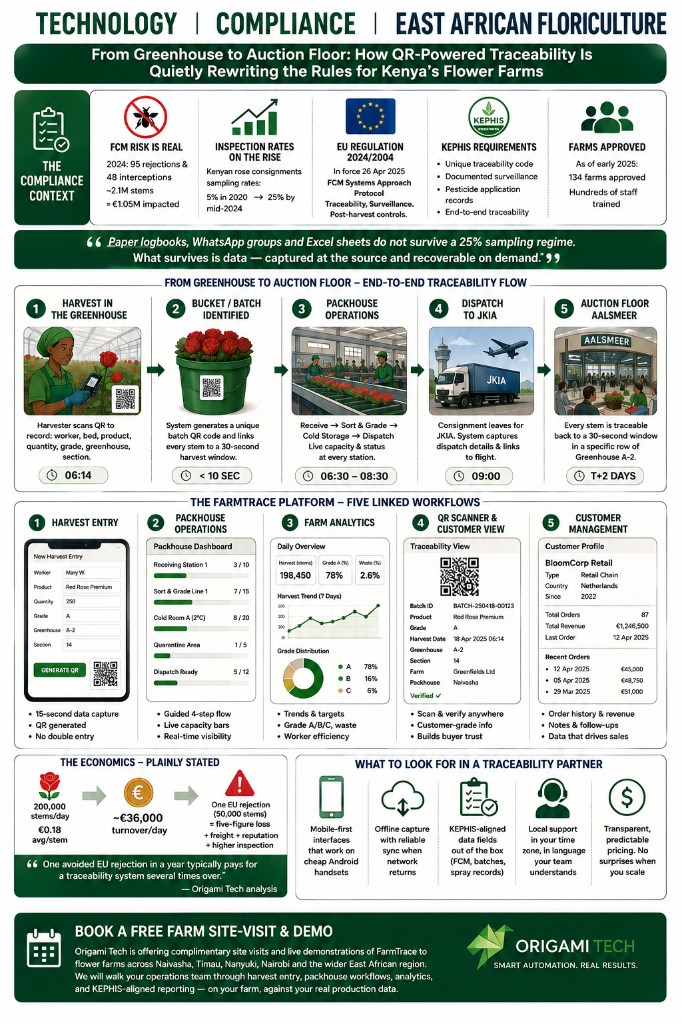
Technology · Compliance · East African Floriculture — Kenya's flower export industry faces a new inspection reality. Paper logbooks, WhatsApp groups, and Excel sheets do not survive a 25% sampling regime. What survives is data — captured at the source and recoverable on demand.
The compliance context
FCM rejections (2024)
95 rejections · 48 interceptions
Stems impacted
~2.1M stems
Estimated cost
€1.05M
Kenyan rose sampling rate
5% (2020) → 25% (mid-2024)
EU Regulation 2024/2004 entered force on 26 April 2025, requiring the FCM Systems Approach Protocol: traceability, surveillance, and post-harvest controls. KEPHIS now expects unique traceability codes, documented surveillance, pesticide application records, and end-to-end chain of custody. As of early 2025, 134 farms were approved with hundreds of staff trained.
End-to-end traceability flow
- 06:14 — Harvest in the greenhouse: worker scans QR, records worker ID, bed, product, quantity, grade, greenhouse, and section.
- < 10 sec — Bucket / batch identified: system generates a unique batch QR linking every stem to a harvest window.
- 06:30–08:30 — Packhouse: Receive → Sort & Grade → Cold Storage → Dispatch, with live capacity and status tracking.
- 09:00 — Dispatch to JKIA: consignment details captured and linked to flight documentation.
- T+2 days — Auction floor Aalsmeer: every stem traceable back to its specific row and harvest window.
The FarmTrace platform — five linked workflows
FarmTrace connects harvest entry, packhouse operations, farm analytics, QR scanner and customer view, and customer management into one traceability backbone. A supervisor logs a spray event; PHI validation blocks premature harvest; packhouse staff log cold-chain readings; compliance packs export as CSV or PDF for auditors; buyers scan a QR and see the full journey.
- Harvest Entry — 15-second mobile capture with instant QR generation
- Packhouse Operations — real-time station status across receiving, grading, cold room, and dispatch
- Farm Analytics — daily overview of harvest volume, Grade A percentage, and waste trends
- QR Scanner & Customer View — buyer-facing traceability from farm origin to packhouse
- Compliance Reports — GLOBALG.A.P., KEPHIS, MPS, and FSI evidence mapped per batch
The economics — plainly stated
A farm producing 200,000 stems per day at €0.18 per stem has roughly €36,000 in daily turnover. One EU rejection of 50,000 stems is a five-figure loss — plus freight, reputation damage, and higher future inspection rates.
“One avoided EU rejection in a year typically pays for a traceability system several times over.”
What to look for in a traceability partner
- Mobile-first interfaces for affordable Android handsets in the field
- Offline capture with reliable sync when connectivity returns
- KEPHIS-aligned data fields — FCM batches, spray records, export documentation
- Local support in the same time zone and language
- Transparent, predictable pricing without per-stem surprises
Origami Tech offers free farm site visits and demos across Naivasha, Timau, Nanyuki, and Nairobi — showing FarmTrace live from spray log to compliance pack to buyer QR page.